English
 Русский
 Español
 عربي




When selecting a manhole cover or gully grating for a construction project, one of the first specifications to check is its EN 124 load class. You may see ratings such as A15, B125, C250, D400, E600, or F900 in product catalogs and technical drawings. But what do these classifications actually mean, and how do you know which one is suitable for your project?
EN 124 load classes help engineers, contractors, distributors, and buyers select manhole tops and gully tops according to their intended installation areas and standardized load performance. Choosing the right class is not simply about selecting the strongest cover. It is about matching the product, supporting frame, and installation conditions to the traffic and service environment.
As a manufacturer of ductile iron and composite manhole covers, FLinSky works with products designed for different infrastructure applications, from pedestrian areas to roads, industrial sites, and airports. This guide explains the EN 124 classifications, their typical applications, and the factors buyers should consider before placing an order.
What Does the EN 124 Standard Cover?
EN 124 is a European standard for gully tops and manhole tops installed in areas used by pedestrians and vehicles. It provides requirements for product performance, testing, and classification according to the intended installation location and load category.
The standard is divided into different parts according to product materials. For example, EN 124-2 applies to gully tops and manhole tops made of cast iron, while EN 124-5 covers products made of composite materials. Therefore, when purchasing a manhole cover, buyers should check not only its load class but also the relevant part of the standard for its material.
One important point is that an EN 124 classification applies to the tested product assembly and its performance under specified test conditions. The cover, frame, and supporting installation all matter. A load-class marking alone should not be treated as proof that every installation will perform correctly.
What Do the Load Class Numbers Mean?
EN 124 defines six main load classes, from A15 to F900. The number represents the standardized test load expressed in kilonewtons (kN). A higher class indicates a higher test load requirement, but it does not directly represent the maximum weight of a vehicle that can drive over the cover.
The following table provides an overview of the six classes and their commonly specified installation areas.
| EN 124 Class | Test Load | Approx. Tonne-Force Equivalent | Typical Installation Area |
|---|---|---|---|
| A15 | 15 kN | 1.53 tf | Pedestrian and cycle-only areas |
| B125 | 125 kN | 12.75 tf | Footways, pedestrian areas, and car parks |
| C250 | 250 kN | 25.49 tf | Gully tops in defined kerbside channels |
| D400 | 400 kN | 40.79 tf | Road carriageways and parking areas for road vehicles |
| E600 | 600 kN | 61.18 tf | Areas exposed to high wheel loads, such as docks |
| F900 | 900 kN | 91.77 tf | Areas exposed to particularly high wheel loads, such as airport pavements |
Note: The tonne-force figures are mathematical conversions of the standardized test loads. They are not vehicle weight limits, axle-load limits, or permissible operating loads. Always refer to the applicable EN 124 requirements and project specifications when selecting a product.
A15 and B125: Which Areas Are Suitable for Light-Duty Covers?
A15 and B125 are commonly used for areas where pedestrian activity is the main consideration and heavy road traffic is not expected.
A15: This class is intended for areas used exclusively by pedestrians and cyclists. Typical applications include footpaths, pedestrian zones, landscaped areas, and similar spaces where motor vehicles are not expected to pass over the cover.
B125: B125 provides a higher load classification and is commonly used in footways, pedestrian areas, and comparable spaces, including car parks and parking decks. It may be suitable where occasional vehicle access is expected, provided the actual installation conditions meet the relevant requirements.
For residential developments, sidewalks, landscaping projects, and light-duty drainage systems, buyers may compare A15 and B125 light duty manhole covers according to the location, required dimensions, and material specifications.
C250: What Makes This Class Different?
C250 is often misunderstood as a general-purpose class for all medium-traffic areas. Under EN 124, Group 3 has a more specific application: gully tops installed in kerbside channels, extending a maximum of 0.5 m into the carriageway and a maximum of 0.2 m into the footway, measured from the kerb edge.
This distinction matters when specifying drainage covers near road edges. A product rated C250 should not automatically be selected for every parking area, industrial road, or location with slow-moving heavy vehicles. The actual installation position and project requirements must be checked.
For projects that require this classification, FLinSky provides C250 ductile iron manhole covers. Buyers should confirm the clear opening, frame dimensions, sealing design, and supporting test documentation before finalizing a specification.
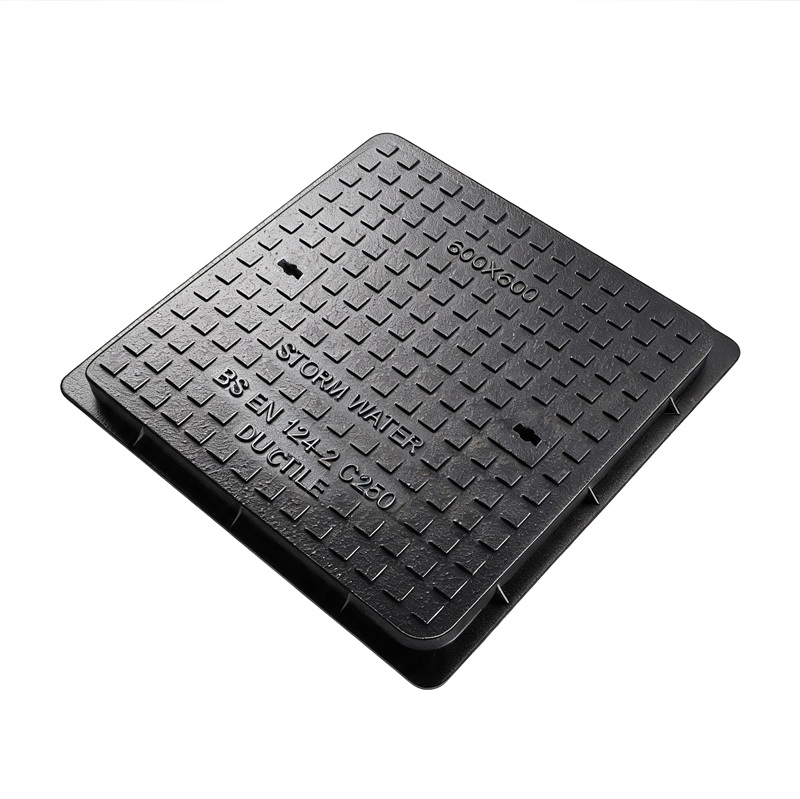
C250 medium-duty ductile iron manhole cover
D400: The Common Choice for Road Traffic
D400 is one of the most widely specified classes for road infrastructure. It is intended for carriageways, hard shoulders, and parking areas used by road vehicles. Applications may include urban roads, commercial parking areas, access roads, and other locations where vehicles regularly pass over underground access points.
D400 products are commonly manufactured from ductile iron because this material offers a combination of strength, toughness, and durability for demanding infrastructure environments. However, the product design, frame support, installation quality, and test documentation are equally important when evaluating performance.
FLinSky's D400 medium duty square ductile iron manhole covers include a 600 × 600 mm clear opening option. The product page lists a 735 × 735 × 80 mm frame and road carriageways as an intended application. Project buyers should still verify the required dimensions and product documentation against their own drawings and local specifications.
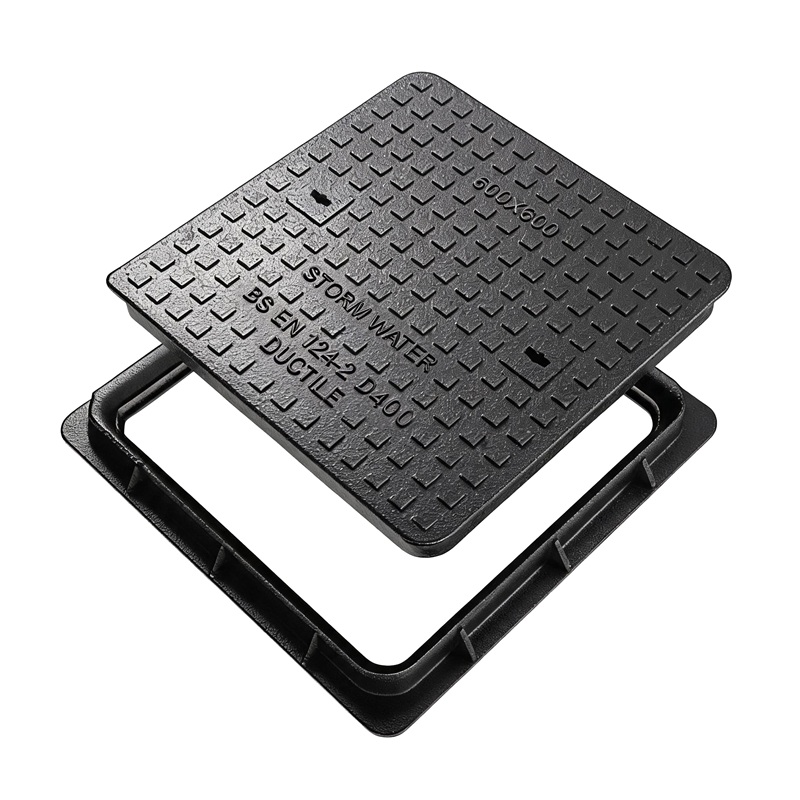
D400 ductile iron manhole cover for road applications
E600 and F900: When Are Heavy-Duty Covers Required?
E600 and F900 are designed for applications involving higher and particularly high wheel loads. They are generally considered for infrastructure environments where ordinary road-duty specifications may not be sufficient.
E600 is intended for areas exposed to high wheel loads. Typical examples include docks, port facilities, and certain aircraft pavement areas. It may also be considered for specialized industrial environments, subject to the project engineer's requirements.
F900 is the highest of the six main EN 124 load classes. It is intended for areas exposed to particularly high wheel loads, such as airport pavements. Other possible applications may include demanding transportation or industrial infrastructure, where the specified loading conditions justify this class.
For projects involving ports, airports, and other heavy-duty infrastructure, FLinSky offers E600 and F900 heavy duty ductile iron manhole covers and gratings. The selected model should be matched to the required load class, opening size, frame configuration, and verified test results.
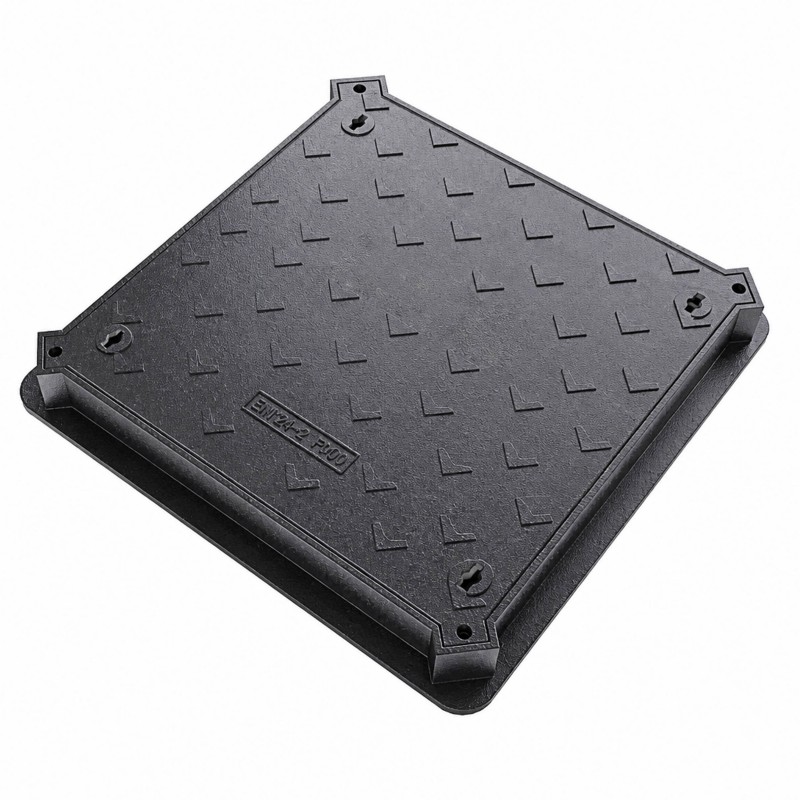
F900 heavy-duty ductile iron manhole cover for demanding infrastructure
How to Choose the Right EN 124 Load Class
Choosing a manhole cover based only on its load-class number can lead to incorrect product selection. A practical specification should consider the installation environment, expected traffic, product material, frame design, and project standards together.
Check the actual installation location. Determine whether the cover will be installed in a pedestrian area, footway, kerbside channel, carriageway, parking area, dock, or airport pavement. The installation group is a key part of selecting the correct load class.
Confirm the material and applicable standard part. Ductile iron and composite products may fall under different parts of EN 124. Make sure the product documentation matches the material being supplied.
Verify dimensions and frame compatibility. Check the clear opening, external frame dimensions, cover thickness, seating arrangement, and installation depth. These details affect whether the product fits the chamber and project drawings.
Review the complete product documentation. Ask for relevant test reports, material specifications, certificates, and details of the tested cover-and-frame assembly. Do not rely solely on a load-class label in a catalog.
Consider site conditions and additional features. Depending on the project, requirements may include locking devices, sealing performance, anti-slip surfaces, corrosion resistance, noise reduction, and drainage capacity.
What Should Buyers Confirm Before Ordering?
For distributors, contractors, and infrastructure project buyers, providing clear technical information at the quotation stage can help reduce specification errors and avoid unnecessary changes during production or installation.
| Information | What to Provide or Confirm |
|---|---|
| Load class | A15, B125, C250, D400, E600, or F900 |
| Installation area | Footway, road, parking area, dock, airport, or another specified location |
| Material | Ductile iron, cast iron, or composite material |
| Dimensions | Clear opening, frame size, cover size, and installation depth |
| Design requirements | Round or square shape, locking, sealing, surface pattern, and logo requirements |
| Compliance documents | Applicable EN 124 part, test reports, certificates, and project-specific approvals |
FLinSky supplies ductile iron and composite manhole covers, frames, and gully gratings for different infrastructure requirements. When requesting a quotation, buyers can provide the required load class, drawings, dimensions, material, and installation environment. This helps the technical team evaluate a suitable product configuration rather than relying on a load rating alone.
Frequently Asked Questions About EN 124 Load Classes
What is the difference between A15 and B125 manhole covers?
A15 is intended for areas used exclusively by pedestrians and cyclists. B125 is designed for footways, pedestrian areas, and comparable locations such as car parks and parking decks. The correct choice depends on the actual installation area and expected traffic.
Is C250 suitable for all parking areas?
No. C250 is intended for gully tops installed in defined kerbside channels under EN 124 Group 3. General parking areas used by road vehicles are typically associated with D400, subject to the project's specifications and installation conditions.
Is D400 the standard choice for road manhole covers?
D400 is commonly specified for carriageways, hard shoulders, and parking areas for road vehicles. The final selection should still follow local regulations, project drawings, and the required product documentation.
What is the difference between E600 and F900?
E600 is intended for areas exposed to high wheel loads, such as docks. F900 is intended for areas exposed to particularly high wheel loads, including certain airport pavements. F900 has a higher standardized test load than E600.
Does a D400 manhole cover mean it can support a 40-ton truck?
Not exactly. The 400 in D400 refers to a standardized test load of 400 kN, not a permitted vehicle gross weight. Vehicle weight, axle configuration, wheel contact, installation quality, and the supporting structure are different considerations.
Are ductile iron and composite manhole covers covered by the same EN 124 part?
Not necessarily. EN 124 is divided into parts according to material. EN 124-2 covers cast iron products, while EN 124-5 covers composite material products. Buyers should check which part applies to the selected product.
What information should I provide when requesting a manhole cover quotation?
Provide the required load class, installation location, material, clear opening, frame dimensions, shape, quantity, and any project-specific standards or drawing requirements. Test reports and compliance documents should also be confirmed before ordering.
Can I select a higher load class to be safer?
A higher class is not automatically the best choice for every project. The product should match the installation group, dimensions, supporting structure, and project requirements. Confirm the specification with the project engineer or relevant authority before ordering.
Select the Right Manhole Cover for Your Project
Understanding EN 124 load classes is an important first step when specifying manhole covers and gully gratings. A15 and B125 are associated with pedestrian and lighter-duty areas, C250 is intended for a defined kerbside gully zone, D400 is commonly used for road traffic, while E600 and F900 address higher wheel-load environments.
The right product is determined by more than the number stamped on the cover. Installation location, material, dimensions, frame design, test documentation, and local project requirements all need to be considered together.
FLinSky provides ductile iron and composite manhole covers and drainage products for infrastructure projects with different technical requirements. Contact the team with your drawings, load class, dimensions, and application details to discuss a suitable product configuration.
Email: rae.w@feilong-group.com
Phone: +86 188 2526 5625



 Network Supported