 English
 Русский
 Español
 عربي
عربي
-

Email : rae.w@feilong-group.com
-

Tel : +86 188 2526 5625
-

Address : Anhui, Hefei, China


Email : rae.w@feilong-group.com
Tel : +86 188 2526 5625
Address : Anhui, Hefei, China
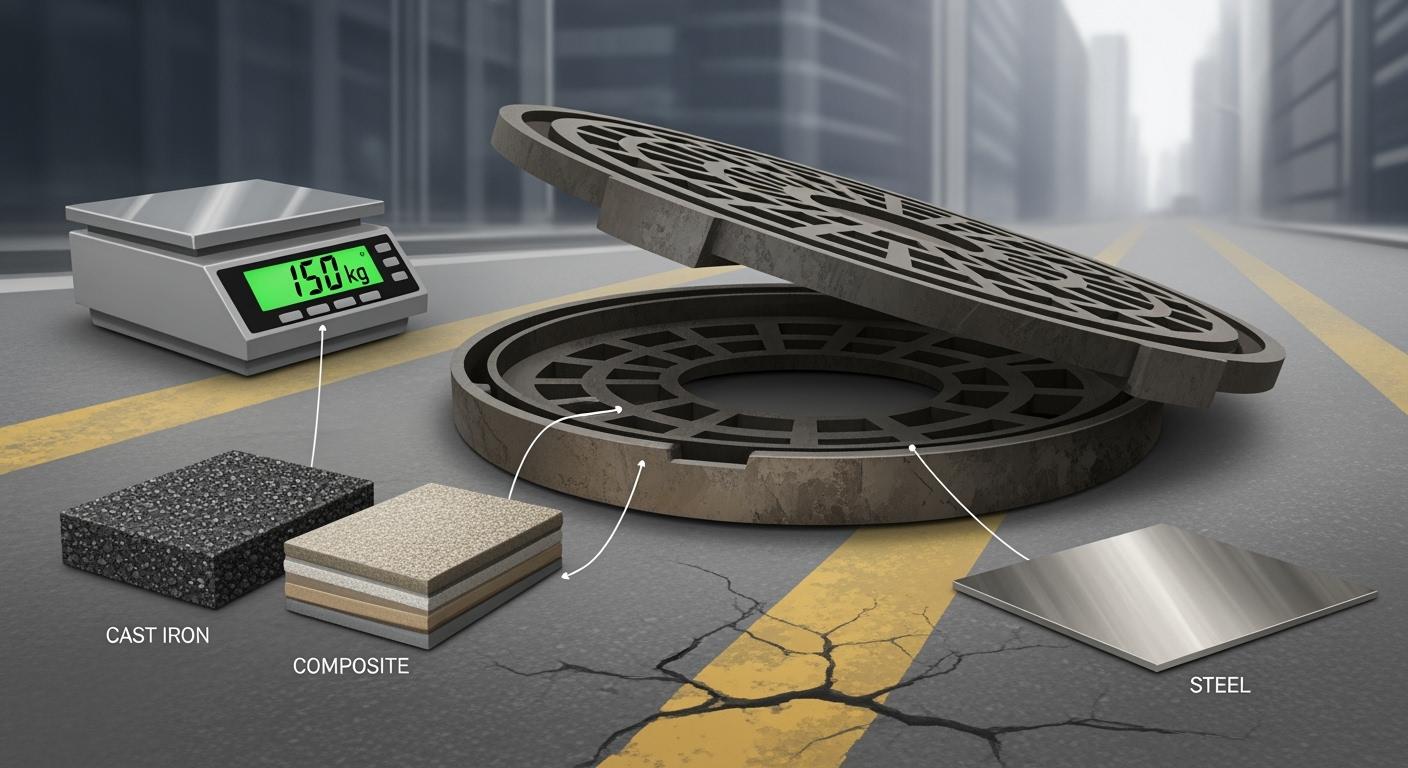
When you ask what is a manhole cover, you need to consider both weight and material. In 2026, most manhole covers use cast iron, duct iron, or composite materials. The table below shows standard weight ranges by type and diameter:
|
Type of Manhole Cover |
Diameter |
Weight Range |
|---|---|---|
|
Composite |
18 in |
15 – 30 lbs |
|
Composite |
24 in |
30 – 55 lbs |
|
Composite |
30 in |
50 – 70 lbs |
|
Composite |
36 in |
65 – 90 lbs |
|
Cast Iron |
18 in |
80 – 130 lbs |
|
Cast Iron |
24 in |
150 – 275 lbs |
|
Cast Iron |
30 in |
240 – 375 lbs |
|
Cast Iron |
36 in |
340 – 500 lbs |
|
Mild Steel |
24 in |
35 – 70 lbs |
|
Mild Steel |
30 in |
70 – 100 lbs |
|
Mild Steel |
36 in |
110 – 150 lbs |
|
Galvanized Steel |
24 in |
40 – 80 lbs |
|
Galvanized Steel |
30 in |
80 – 120 lbs |
|
Galvanized Steel |
36 in |
120 – 160 lbs |
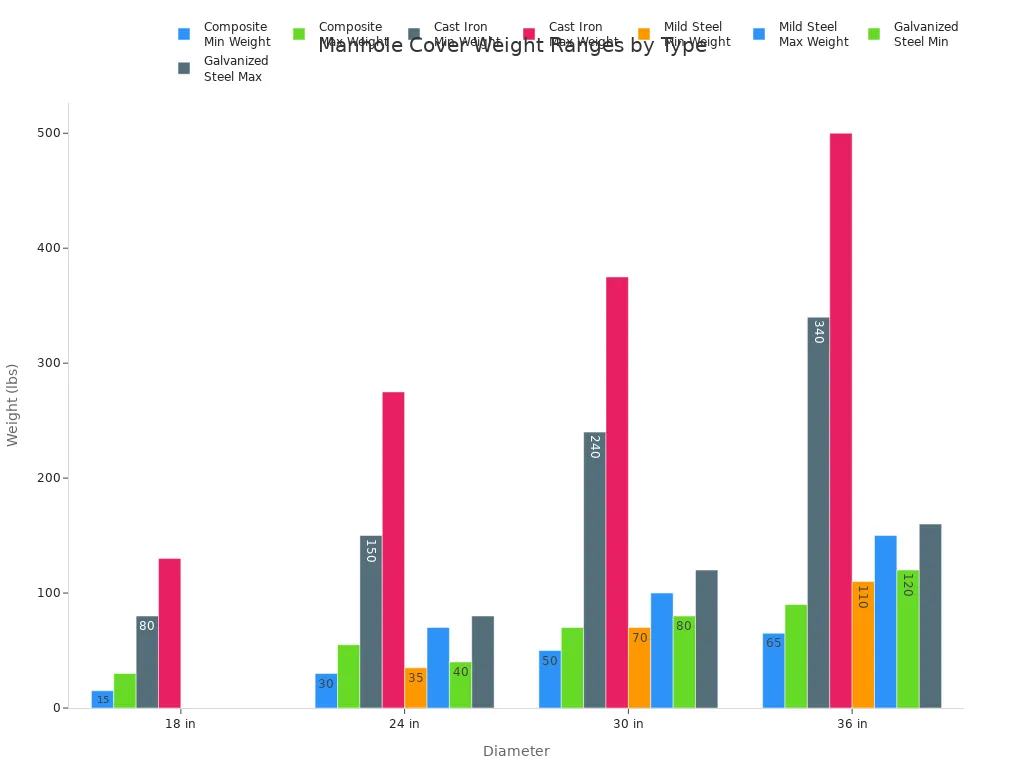
You see cast iron dominating where strength matters, while composite covers suit lighter, low-traffic placements. Knowing what is a manhole cover and its material helps you match the right product to your site. Standards exist to protect safety and durability. These requirements prevent accidents, lengthen infrastructure life, and shield utilities from damage.
Cast iron: strong, handles heavy loads.
Duct iron: lighter, resists cracking.
Composite: light, corrosion-resistant.
Always follow local standards when selecting a manhole cover to keep your project safe and compliant.
Manhole covers come in various materials like cast iron, ductile iron, and composite. Each material has unique properties that affect weight and performance.
Weight standards for manhole covers vary by type and application. Cast iron covers are heavier and suited for high-traffic areas, while composite covers are lighter and ideal for low-traffic locations.
Always match the manhole cover's load rating to its intended use. For roads, an H-20 rating is standard, while lighter ratings are suitable for sidewalks and green spaces.
Local regulations dictate minimum weight and load capacity for manhole covers. Always verify compliance to ensure safety and avoid penalties.
Trends in 2026 show a shift towards sustainable materials and smart technology in manhole covers, enhancing safety and reducing maintenance costs.

You often ask how much does a manhole cover weigh when planning a project. The answer depends on the material, diameter, and load class. Standard cast iron manhole cover options weigh much more than composite or steel covers. You see standard round manhole covers in cast iron ranging from 80 to 500 lbs, while composite covers weigh between 15 and 90 lbs. Steel covers fall in the middle, and FRP covers offer lightweight alternatives. Square manhole covers may weigh slightly more due to their shape and reinforcement.
Here is a quick summary of typical weight ranges for manhole covers by material:
|
Material |
Typical Weight Range (24 in) |
|---|---|
|
Cast Iron |
150 – 275 lbs |
|
Composite |
30 – 55 lbs |
|
Mild Steel |
35 – 70 lbs |
|
FRP (Fiberglass) |
25 – 50 lbs |
You must consider the weight of a manhole cover for installation and maintenance. Heavy-duty manhole covers require special handling equipment. Lightweight composite covers allow easier access and reduce labor costs. Feilong offers a wide range of manhole covers to suit every weight and load class requirement.
Manhole cover weight standards rely on load ratings and load class. You need to match the load class to the expected traffic and application. The most common load rating systems in 2026 include H-20, H-25, and EN124. These standards define the minimum load a manhole cover must withstand.
|
Load Rating |
Axle Weight |
Wheel Weight |
Application |
|---|---|---|---|
|
H-20 |
32,000 lbs |
16,000 lbs |
Minimum for road installations |
|
H-25 |
40,000 lbs |
20,000 lbs |
Heavy industrial roads, ports, container yards |
You select an H-20 load rating for most road installations. This rating ensures the manhole cover weight and structure can handle a 32,000 lb axle load. For heavy-duty manhole covers in industrial areas, you choose H-25 load class. EN124 defines load classes from A to F, covering pedestrian to special applications.
|
Load Class |
Description |
Minimum Compressive Test Load |
|---|---|---|
|
Class A |
Pedestrian areas |
1.5 kN |
|
Class B |
Light vehicular areas |
5 kN |
|
Class C |
Medium vehicular areas |
12 kN |
|
Class D |
Heavy vehicular areas |
25 kN |
|
Class E |
Very heavy vehicular areas |
40 kN |
|
Class F |
Special applications |
60 kN |
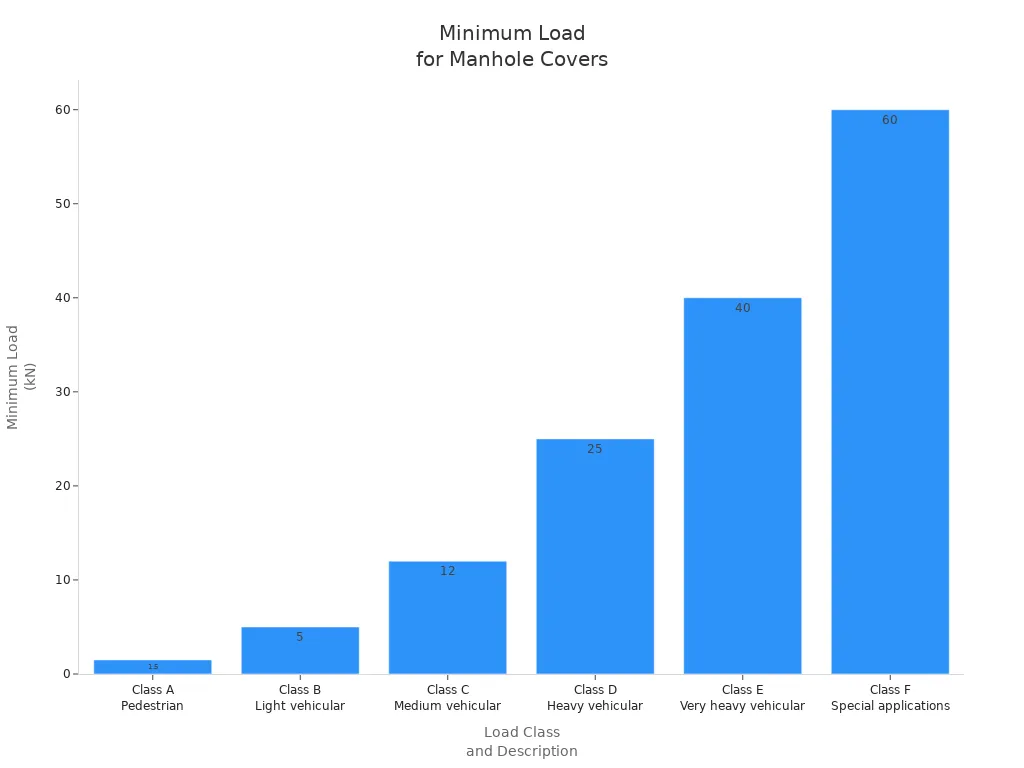
You must always check the standard specification for manhole cover standards before selecting a product. The right load class prevents premature failure and ensures safety.
You need to understand minimum weight requirements for manhole covers and rings. According to 2026 standards, manhole covers with an H-20 load rating must withstand a proof load of 40,000 lbs. This requirement gives you a safety margin above the design load of 16,000 lbs, which matches a standard 20-ton truck. The minimum combined weight of a manhole cover and ring ensures the structure resists deformation and cracking under traffic.
You find that cast iron manhole covers meet these requirements for most urban roads. Composite and FRP covers suit lighter applications but must still comply with the minimum load class. Local regulations may set higher standards for critical infrastructure. Feilong engineers design manhole covers to exceed these minimums, giving you peace of mind and long-term durability.
Always verify the weight of a manhole cover and its load class before installation. You protect your project and ensure compliance with manhole cover standards.

When you consider what is manhole cover made of, you find several main types in 2026. Each material brings unique properties that affect performance, weight, and cost. Understanding the types of manhole covers helps you select the right solution for your project.
Cast iron manhole covers remain a popular choice for many urban and industrial settings. You see these covers where strength and durability matter most. Ductile iron manhole covers offer improved flexibility and shock resistance, making them ideal for high-traffic areas. Feilong, a leader in the industry, manufactures both cast iron and ductile iron covers that meet strict standards.
|
Feature |
Cast Iron Manhole Covers |
Ductile Iron Manhole Covers |
|---|---|---|
|
Corrosion Resistance |
Non-corrosive but limited in harsh environments |
Very high resistance to corrosion |
|
Strength |
Sturdier but brittle, limited impact resistance |
Strong, flexible, and shock-resistant |
|
Weight |
Heavier, making transport and installation harder |
Lighter, easier to transport and install |
|
Cost |
Generally cheaper to produce and distribute |
More expensive due to advanced manufacturing process |
|
Best Use Areas |
Suitable for moderate environments |
Ideal for busy areas like highways and airports |
You benefit from the high load capacity of these manhole cover types, but you must consider the extra weight and handling needs.
Composite manhole cover options have grown rapidly from 2020 to 2026. You now see these covers in more municipal and commercial projects. FRP (Fiberglass Reinforced Plastic) covers, a type of composite, offer lightweight, rust-resistant solutions.
|
Advantages of Composite Manhole Covers |
Traditional Materials Limitations |
|---|---|
|
Lightweight with high load-bearing capacity |
Heavy weight |
|
Excellent corrosion and chemical resistance |
Corrosion risks |
|
Non-conductive and anti-theft properties |
High transportation costs |
|
Stable quality and repeatable production |
|
Lighter weight: Composite covers can be up to 70% lighter than ductile iron.
Corrosion resistance: Composites do not rust, reducing maintenance.
Non-conductive: Safe for use near electrical utilities.
Low theft incentive: No scrap value, so fewer thefts.
Safer surfaces: Molded anti-slip textures improve safety.
Lower total cost of ownership: Less maintenance and fewer replacements.
Higher initial cost: You may pay more upfront.
Limited awareness: Some users still prefer traditional types.
The growing use of FRP manhole covers improves safety and reduces maintenance. You reduce worker strain and avoid theft risks. Feilong leads the market with advanced composite and FRP covers designed for modern infrastructure.
Steel manhole cover products offer a balance between strength and design. You often choose these covers for facilities that require both durability and a modern look.
|
Advantages |
Disadvantages |
|---|---|
|
Long lasting |
More costly to produce compared to cast iron or concrete |
|
Visually appealing due to contemporary design |
|
|
Durable structure |
|
|
Suitable for facilities requiring functionality and perception |
|
You find steel covers in commercial complexes and areas where aesthetics matter.
You need to compare the main manhole cover types to make the best choice:
|
Material |
Weight (kg) |
Durability |
Cost |
|---|---|---|---|
|
Cast Iron |
75 |
Medium |
Cheaper |
|
Ductile Iron |
80 |
High |
Moderate |
|
Stainless Steel |
N/A |
Very High |
More Expensive |
|
Fiberglass |
50 |
High |
Middle-range |
|
Concrete |
100 |
Medium |
Affordable |
Concrete manhole covers remain an affordable option for low-traffic areas, but you face challenges with their weight and installation. You see that manhole cover types like composite and FRP now dominate where lightweight, corrosion resistance, and safety matter most. When you ask what is manhole cover made of, you must consider the application, weight, and long-term costs. Feilong continues to innovate across all types of manhole covers, offering solutions for every need.
You must consider size and shape when selecting manhole covers for your project. Larger covers require more material, which increases their weight and enhances their load-bearing capacity. The thickness of a manhole cover also plays a critical role in supporting heavy vehicles. Round covers remain the most common choice because they cannot fall through their openings, providing extra safety. The shape affects how well the cover fits and functions in different environments. You see round covers in sizes like 18, 24, and 30 inches, while square or rectangular covers are used for specialized access points.
|
Shape |
Common Sizes (mm) |
Common Sizes (inches) |
|---|---|---|
|
Round |
450, 600, 750 |
18, 24, 30 |
|
Square/Rectangular |
300x300, 400x400, 900x900 |
N/A |
The application determines the required load and capacity for manhole covers. You must match the cover to the expected traffic and environment. Roadways demand heavy-duty manhole covers with high load ratings, such as H-20, to withstand vehicle traffic. Sidewalks and green spaces require lighter covers, but you must ensure they can handle occasional maintenance vehicles. Interior mechanical rooms and building vaults need covers designed for foot traffic and equipment loads. The load-bearing capacity must align with the application to prevent premature failure.
|
Application Type |
Required Load Rating |
Notes |
|---|---|---|
|
Roadways |
H-20 |
Minimum requirement for any cover in or adjacent to traveled roadways. |
|
Sidewalks or pedestrian access |
Light/Medium Duty |
Suitable unless vehicles can mount the curb. |
|
Interior mechanical rooms/building vaults |
Foot traffic only |
Designed for foot traffic and equipment loads. |
|
Green spaces |
Light Duty |
Adequate unless maintenance vehicles cross the cover. |
|
Load Class |
Typical Application |
|---|---|
|
A15 |
Pedestrian areas, gardens, and light foot traffic zones |
|
B125 |
Sidewalks, pedestrian streets, and small parking areas |
|
C250 |
Kerbside areas, road shoulders, and light traffic zones |
|
D400 |
Main roads, carriageways, and heavy vehicle traffic areas |
|
E600 |
Industrial yards, docks, and heavy-duty working areas |
|
F900 |
Airports, ports, and extreme load environments |
You protect your infrastructure by choosing manhole covers with the right load-bearing capacity for each application. Feilong engineers design covers to meet these demands, ensuring safety and durability.
Local regulations set minimum standards for manhole cover weight and load capacity. You must comply with these rules to avoid penalties and ensure public safety. Regulations specify the minimum load a cover must withstand, often based on traffic patterns and environmental conditions. You find that urban areas require heavy-duty manhole covers, while rural or low-traffic zones allow lighter options. Feilong provides covers that meet or exceed local standards, helping you achieve compliance and long-term reliability.
Always check local codes before installation. You ensure your manhole covers meet all requirements and deliver lasting performance.
Selecting the right manhole covers for your project starts with understanding the application. You need to confirm the load rating from your project drawings. For municipal roadway applications, you must use H-20 as the minimum standard. Sidewalks or non-traffic areas can use lighter ratings. The material matters as well. Cast iron works best for traditional service, while composite covers offer corrosion resistance. Steel covers suit non-traffic access points. You should choose round covers for roadways and square or rectangular shapes for vaults. Always verify the clear opening dimension to ensure compatibility. Include all necessary accessories in your submittal to avoid costly change orders.
When heavy vehicles like buses or trucks pass over a cover, the pressure can cause movement or even open a hole in the road. This creates hazards for both pedestrians and vehicles. Lightweight covers are easier to tamper with or steal, which increases accident risk. You should always select load-rated and weight-appropriate covers for safety and compliance.
You must balance cost, durability, and compliance when choosing manhole covers. Start by evaluating material performance. Cast iron provides strength for heavy-duty manhole covers in high-traffic zones. Composite materials reduce weight and resist corrosion, making them ideal for lighter uses. Design features like anti-slip surfaces and secure fastening improve safety and help you meet regulations. Compliance with standards such as EN 124 and AASHTO ensures durability and reduces future costs from accidents or replacements. Feilong offers a range of covers that meet these requirements, giving you reliable options for every project.
In 2026, you see a shift toward sustainable and durable materials. Ductile iron and composite covers are popular for their long service life. The market values longevity to lower maintenance costs. Enhanced grip designs and reflective elements improve safety in urban areas. Aesthetic appeal matters more, with custom designs reflecting local culture. Smart technology features, such as locking mechanisms and sensors, are becoming standard. Compliance with load ratings remains critical, as many regions enforce strict standards to protect public safety. Feilong leads with innovative solutions that address these trends and help you meet every project requirement.
You now understand the standard weights and materials for manhole covers in 2026. Feilong offers solutions that help you meet safety and durability requirements. Always match the manhole cover to your application and follow local regulations. Monroe County provides detailed resources for specifications and selection criteria, ensuring you stay compliant. Review these documents before starting your project to avoid costly mistakes.
You see cast iron as the most common material for manhole covers. It provides excellent strength and durability for urban and industrial environments.
You match the cover weight to the expected traffic and application. Heavier covers suit roads and highways. Lightweight options work best for sidewalks and green spaces.
Composite covers can handle heavy loads if you select the correct load rating. Always check the manufacturer’s specifications and local standards before installation.
You can find reliable manhole covers from trusted brands like Feilong. They offer a wide range of products that meet international standards and local regulations.

Add: Hanshan Industrial Area ( Lintou ), Maanshan City, Anhui Province, China



Please read on, stay posted, subscribe, and we welcome you to tell us what you think.
Copyright © 2026 Anhui Feilong New Material Co., Ltd All Rights Reserved.
Sitemap
|
Blog
|
Xml
|
Privacy Policy
 Network Supported
