English
 Русский
 Español
 عربي
عربي
-

Email : rae.w@feilong-group.com
-

Tel : +86 188 2526 5625
-

Address : Anhui, Hefei, China


Email : rae.w@feilong-group.com
Tel : +86 188 2526 5625
Address : Anhui, Hefei, China
Selecting the right composite manhole cover ensures durability, safety, and compliance for your project. You need to consider several essential factors: application, material, load capacity, size, thickness, aesthetics, safety, and compliance. Industry experts highlight the importance of quality, material selection, standards, load-bearing capacity, and environmental considerations:
|
Factor |
Description |
|---|---|
|
Quality |
Longevity and effectiveness depend on robust construction. |
|
Material Selection |
Materials offer unique benefits and costs. |
|
Compliance with Standards |
Standards guarantee reliability and safety. |
|
Load-Bearing Capacity |
Heavy traffic demands strong covers. |
|
Environmental Considerations |
Corrosion resistance and maintenance affect long-term value. |
These buying guide tips help you choose the right manhole cover confidently.
Choose the right composite manhole cover based on your site's specific application and environmental conditions to ensure durability and safety.
Select materials that resist corrosion and require less maintenance, which can save time and costs in the long run.
Always check the load capacity ratings to match the manhole cover with the expected traffic and usage to prevent damage.
Ensure compliance with local codes and standards to avoid legal issues and ensure public safety.
Consider aesthetics and design features to enhance the visual appeal of your project while maintaining functionality.

You need to consider the application and location before selecting a composite manhole cover. Start by examining the environment where the manhole cover will be installed. Different conditions affect performance and durability. For example, exposure to chemicals, moisture, or extreme temperatures can impact how long the cover lasts and how well it functions. If you install a manhole cover in an industrial area, you must choose the right material that resists chemical attacks. In outdoor settings, UV exposure can cause surface aging, so you should select the right size and shape that fits the environment and withstands weather changes.
Tip: Always match the features of the composite manhole cover to the specific needs of your site. This ensures safety and longevity.
The table below shows how environmental conditions influence performance:
|
Environmental Condition |
Impact on Performance |
|---|---|
|
Chemical Exposure |
Protects against moisture and chemical attack, enhancing durability in corrosive environments. |
|
Extreme Temperatures |
Resists warping and brittleness, maintaining structural integrity over time. |
|
UV Exposure |
Prevents excessive surface aging, ensuring longevity in outdoor settings. |
|
Moisture Levels |
Designed to withstand prolonged exposure, crucial for stormwater systems and wastewater networks. |
You must also consider the application and location in terms of traffic and frequency. Ask yourself how often vehicles or pedestrians will cross the manhole cover. Heavy traffic areas require covers with higher load capacity. If you expect frequent use, choose the right material that can handle repeated stress. In residential zones, you may select the right size and shape that blends with surroundings and supports lighter loads. In commercial or industrial locations, you need a manhole cover that withstands constant movement and heavy vehicles.
Note: Matching the cover’s features to the site’s traffic and frequency helps prevent damage and ensures reliable performance.
When you consider the application and location, you make informed choices that protect your investment and keep your site safe.
You need to select a manhole cover that resists corrosion, especially if your site faces harsh environmental conditions. Composite manhole covers, including FRP types, offer excellent protection against rust and chemical attacks. This feature makes them ideal for locations with high moisture or chemical exposure. Unlike metal covers, composites do not degrade when exposed to water or corrosive substances. You can rely on material durability to maintain performance over time. Feilong, a trusted brand in the industry, provides composite manhole cover options designed for superior corrosion resistance. For more information about Feilong’s products, you can visit their composite manhole covers page.
Tip: Choose a composite manhole cover for environments where corrosion is a concern. This choice reduces maintenance and extends service life.
You must consider maintenance requirements when selecting a manhole cover. Composite manhole covers require less upkeep than traditional materials. Their lightweight design makes handling easier and reduces theft risk. You can follow these simple steps to maintain your cover:
Clean debris around the frame regularly.
Lubricate hinges if your cover has them.
Check for rocking, which signals worn seating.
Inspect for corrosion in harsh environments.
Ensure proper sealing to control odors.
Proper specification and design help you achieve long-term durability. Composite covers, especially those from Feilong, simplify maintenance and provide reliable performance.
You should compare composite manhole covers with other materials before making your decision. The table below highlights the main advantages and disadvantages:
|
Type of Cover |
Advantages |
Disadvantages |
|---|---|---|
|
Composite |
Lightweight, rust-resistant, easy to handle, no scrap value, chemical resistant, environmentally friendly, safe for electric drains |
Limited structural strength compared to metals |
|
Cast Iron |
Strong, durable, rust-resistant, can be decorative |
Heavy, expensive, prone to theft, requires maintenance |
|
Stronger than cast iron, better for heavy loads, longer-lasting |
More expensive than cast iron, requires coatings to prevent rust |
You gain benefits like easier handling and improved safety with composite covers. Material durability and corrosion resistance make them a smart choice for many applications.
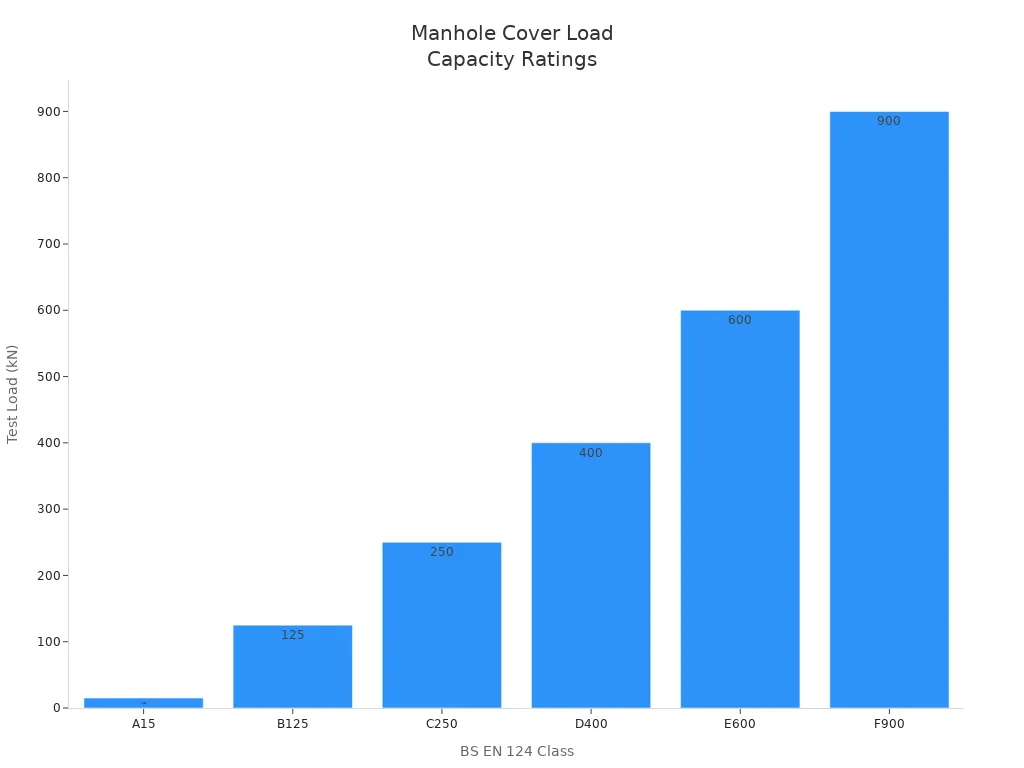
You need to check load capacity before selecting a manhole cover. Industry standards classify covers by their ability to withstand different loads. The BS EN 124 standard provides clear guidance for composite manhole covers. Each class matches a specific application, from pedestrian walkways to heavy truck routes. The table below shows the standard load capacity ratings:
|
BS EN 124 Class |
Test Load (kN) |
Description |
|---|---|---|
|
15 |
Pedestrian areas where vehicles have no access |
|
|
B125 |
125 |
Car parks & pedestrian areas with infrequent vehicle access |
|
C250 |
250 |
Areas of slow moving, heavy traffic |
|
400 |
Carriageways of roads, hard shoulders, and parking areas |
|
|
E600 |
600 |
Areas with high wheel loads |
|
F900 |
900 |
Areas with extremely high wheel loads |
You can also see the differences in load capacity visually:
Composite manhole covers come in several types. The table below highlights typical applications and cover types:
|
Load Class |
Load Capacity |
Typical Application |
FRP Cover Type |
|---|---|---|---|
|
A15 |
15 kN (1.5 Ton) |
Gardens, pedestrian walkways |
Light-duty FRP |
|
B125 |
125 kN (12.5 Ton) |
Driveways, parking areas |
Standard FRP |
|
D400 |
400 kN (40 Ton) |
City roads, truck-access zones |
Heavy-duty FRP |
Tip: Always check load capacity ratings to ensure the manhole cover matches the demands of your site.
You must match the load class to your specific use case. Pedestrian areas require light-duty covers, while city roads and industrial sites need heavy-duty options. The load-bearing capacity becomes critical for locations with frequent vehicle access. For example, industrial sites prioritize load-bearing capacity to support delivery vans and large trucks. In these settings, you need a manhole cover that can handle high wheel loads and constant movement.
When you select a composite manhole cover, consider the type of traffic and the frequency of use. Light-duty covers work well for gardens and walkways. Standard covers suit driveways and parking lots. Heavy-duty covers are best for city roads and truck-access zones. You should check load capacity for each application to prevent damage and ensure safety.
Note: Choosing the right load class protects your investment and keeps your site safe for everyone.
You need to select the right size for your manhole cover to ensure a secure fit and reliable performance. Manufacturers offer composite manhole covers in several standard sizes. The most common clear opening sizes you will find in the market include:
|
Clear Opening Size |
Frame Diameter |
|---|---|
|
450mm |
Matching Frame |
|
800mm |
Matching Frame |
Choosing a standard size helps you simplify installation and replacement. You can also find covers in other dimensions, but these two sizes are widely available and suit many applications.
Accurate measurement is essential when you select a manhole cover. You should measure the clear opening and consider the application area. The table below shows how different sizes and shapes match specific uses and load classes:
|
Size/Type |
Application Area |
Load Class |
Common Dimensions |
|---|---|---|---|
|
Round Covers |
Roads, footpaths, industrial sites |
A15, B125, C250, D400 |
450 mm, 600 mm, 750 mm |
|
Square Covers |
Access panels, cable pits, vaults |
A15, B125 |
300x300 mm, 400x400 mm |
|
Heavy Traffic |
Main roads, industrial areas |
E600, F900 |
900 mm and larger |
|
Residential Areas |
Footpaths, gardens |
A15 |
450 mm |
|
Light Commercial |
Driveways, light-use parking |
B125 |
600 mm |
|
Urban Roads |
Busy roads |
D400 |
600-750 mm |
|
Industrial Areas |
Heavy loads, airports, docks |
E600, F900 |
900 mm and larger |
Tip: Always match the size and shape of your manhole cover to the application area and expected load. This step ensures safety and prevents costly mistakes.
The thickness of a composite manhole cover plays a key role in its strength and durability. A cover with the right thickness will support heavy loads and resist damage from repeated use. You should check that the thickness meets industry standards for your chosen load class. Proper thickness improves structural integrity and helps the cover last longer, even in demanding environments.
Note: Never overlook thickness when you select composite manhole covers. The right thickness keeps your site safe and extends the life of your investment.
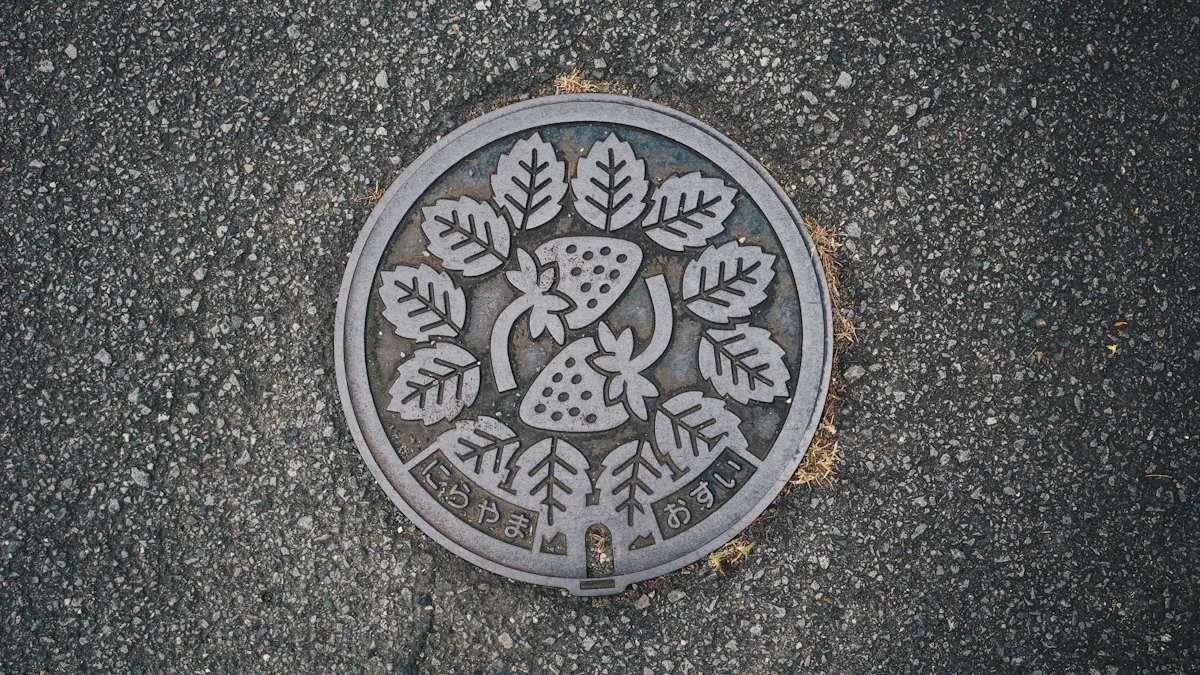
You can enhance the look of your project by choosing the right color for your composite manhole cover. Manufacturers offer a variety of color options that help covers blend with the surrounding landscape. You may select colors that match pavement, grass, or even decorative tiles. This flexibility allows you to create a cohesive appearance in urban or rural settings. Custom colors also help you highlight safety zones or mark utility areas.
Tip: Use colored materials to complement the environment and improve visibility.
The table below shows popular design features that improve urban aesthetics:
|
Design Feature |
Description |
|---|---|
|
Custom Artwork |
Unique designs created by artists that reflect local culture and history. |
|
Color Options |
Use of colored materials to complement surrounding landscapes. |
You can request custom artwork for your composite manhole cover. Artists create designs that celebrate local culture or history. This approach turns a simple cover into a piece of public art. You add value to your project and make the area more attractive.
You want your composite manhole cover to blend seamlessly with its surroundings. Manufacturers mold covers to match pavement textures, colors, or even logos. This feature works well in heritage sites or luxury developments where aesthetics matter. Flush surface designs merge with materials like asphalt, concrete, or tile. You achieve a subtle look that does not distract from the overall landscape.
Note: Sleek profiles eliminate tripping risks and suit high-visibility public spaces.
The table below highlights how design features help covers blend in:
|
Design Feature |
Benefit |
|---|---|
|
Molded to match pavement textures, colors, or logos |
Ideal for aesthetic-sensitive areas like heritage sites or luxury developments |
|
Flush surface design |
Merges with surrounding materials like asphalt, concrete, or tile, enhancing subtlety and aesthetics |
|
Sleek profile |
Eliminates tripping risks, making them suitable for high-visibility public spaces |
You improve safety and visual appeal by selecting covers with these features. You create a unified look that supports both function and style. When you choose the right composite manhole cover, you ensure your project stands out for its quality and design.
You need to prioritize safety and anti-theft features when selecting a manhole cover. Slip-resistant surfaces help prevent accidents, especially in areas with frequent pedestrian or vehicle traffic. Manufacturers design composite covers with textured finishes that improve grip. You can find covers with raised patterns or special coatings that reduce the risk of slipping during wet or icy conditions. These features support maintenance best practices by making routine inspections safer for workers. When you choose slip-resistant surfaces, you protect everyone who uses the site.
Tip: Always check for slip-resistant surfaces to enhance safety and reduce liability.
You must address security concerns by choosing covers with advanced locking mechanisms. Theft and unauthorized access pose risks to public infrastructure and safety. The TwistLIFT® Security Lock offers a tamper-resistant solution. This lock uses a rotating mechanism that cannot be disengaged without the proper tool. You gain peace of mind knowing the cover stays secure and prevents accidental dislodgement. This design also supports maintenance by ensuring the cover remains properly sealed after inspections. You reduce the risk of improper resealing, which can lead to safety hazards.
|
Locking Mechanism |
Security Benefit |
|---|---|
|
TwistLIFT® Security Lock |
Prevents theft and unauthorized access |
|
Tamper-resistant design |
Minimizes accidental dislodgement |
|
Proper tool required |
Ensures only authorized personnel can open |
Note: Secure locking systems protect your investment and support safety and anti-theft features.
You improve site safety by selecting manhole covers with high visibility. Bright colors and reflective markings help pedestrians and drivers spot covers easily. You can request covers with built-in reflectors or painted edges. These features make maintenance tasks safer, especially during nighttime or low-light conditions. Enhanced visibility also supports safety and anti-theft features by deterring tampering and reducing the risk of accidents.
Choose covers with reflective strips for busy roads.
Select bright colors for utility zones.
Request custom markings for high-risk areas.
You ensure that every manhole cover stands out, making your site safer and easier to maintain.
You must always verify that your composite manhole cover meets all relevant local codes before installation. Local authorities enforce building codes to ensure public safety and infrastructure reliability. These codes often specify requirements for materials, load ratings, and installation methods. You should contact your municipal building department to confirm the exact standards for your area.
Provincial building codes are enforced by local municipal building departments.
Authorities certify that building products meet safety standards before use in construction.
Provincial ministries of health and labor regulate safety in workplace products.
If you ignore compliance with standards, you risk costly project delays or even legal penalties. You protect your investment and reputation by choosing products that meet local and international standards. Always request documentation from your supplier to confirm that the composite manhole cover aligns with your region’s regulations.
Certifications play a critical role in ensuring safety and legal protection. Certified products undergo rigorous testing to verify their performance under real-world conditions. When you select a composite manhole cover with recognized certifications, you demonstrate your commitment to compliance with standards and public safety.
The Ontario Court ruling emphasizes that safety is evaluated based on the actual performance of the system in practice, rather than merely having safety policies documented. It highlights that systemic failures in training and hazard identification can lead to significant legal consequences for organizations, reinforcing the necessity of compliance and certification in mitigating legal liability.
You should always look for certifications from respected organizations, such as ISO or EN. These certifications show that the product meets strict quality and safety requirements. Compliance with standards not only protects you from legal issues but also ensures the long-term safety of your site. By prioritizing certified products, you reduce risks and build trust with stakeholders.
You can make the best choice by following a structured process for selecting a composite manhole cover. Use this checklist recommended by industry associations:
Application considerations
Material selection
Load capacity requirements
Size and shape specifications
Safety features
Compliance with industry standards
Consulting with experts helps you understand material advantages, sustainability, and local sourcing. When you focus on proper installation techniques, you reduce long-term costs and avoid maintenance issues.
You need to measure the opening accurately. This ensures the cover fits securely. Always check the specifications before starting installation. Proper measurement prevents gaps and improves safety.
Clean debris around the cover regularly. Inspect for damage or wear. Lubricate hinges if present. Routine maintenance keeps the cover in good condition and extends its service life after installation.
Yes, you can install composite manhole covers in high-traffic zones. Choose covers with the correct load capacity. Installation in these areas requires careful selection to ensure durability and safety.
You need basic tools like a wrench, level, and measuring tape. Some covers require specialized tools for locking mechanisms. Always follow manufacturer instructions for installation to avoid mistakes.
Composite covers are lightweight, so you can remove them easily. Use the proper tools for safe removal. Follow safety guidelines during installation and removal to prevent accidents.

Add: Hanshan Industrial Area ( Lintou ), Maanshan City, Anhui Province, China


Please read on, stay posted, subscribe, and we welcome you to tell us what you think.
Copyright © 2026 Anhui Feilong New Material Co., Ltd All Rights Reserved.
Sitemap
|
Blog
|
Xml
|
Privacy Policy
 Network Supported